
Rector in an Interview with BNR: UNWE Proposes the Establishment of Two Institutes – the Institute for Artificial Intelligence in Economics and the Institute for Enhancing Research Capacity in Nuclear Energy and Nuclear Security
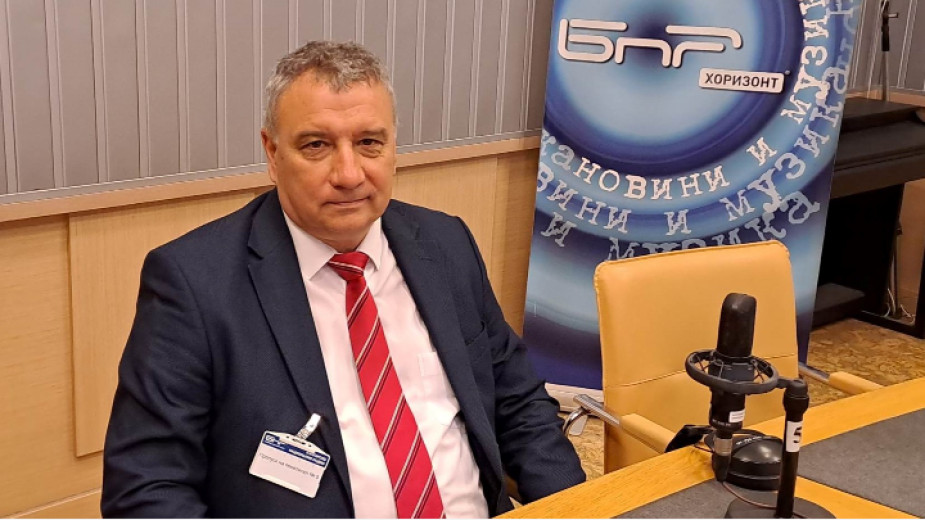
Why should the University of National and World Economy establish an Institute for Artificial Intelligence in Economics and an Institute for Enhancing Research Capacity in Nuclear Energy and Nuclear Security? Yuliana Kornazheva, host of “Horizon at Noon” on BNR, discussed this with Rector Prof. Dr. Dimitar Dimitrov.
Professor Dimitrov, how did the idea to establish these two institutes originate?
We are now beginning to see the application of artificial intelligence everywhere, and in economics, it is absolutely essential and becoming part of everyday life. Many consulting businesses are disappearing, and many tasks related to analysis, strategy, and project work can now be performed by AI. Of course, it is best if AI is intelligently managed by people who understand these processes. Therefore, the qualifications of these individuals need to be enhanced.
On the other hand, the establishment of the Institute for Artificial Intelligence in Economics requires the consolidation of efforts. Currently, each department or individual faculty member experiments and applies AI on their own, but there is a need to unite these efforts within the scientific field. We will not be creating software or writing new AI programs; rather, we will apply AI in areas where it is feasible. UNWE has a large data center, participates in two supercomputer projects, and has connections with the supercomputer at BAS. Therefore, these are not just theoretical activities but practical applications that should be integrated into the educational process through scientific research.
By integrating AI into the educational process, it must then be applied beyond it, reaching every company. What portion of our economy currently uses artificial intelligence in daily operations?
We haven’t conducted such a study. We do run a business barometer, which started last year, and perhaps we will include such questions in the representative survey. There are a few companies offering artificial intelligence solutions, for example in accounting. It should be noted that students are more advanced in using AI than the opportunities provided by the educational program. Faculty members, even if willing, are limited by curricula, syllabi, and existing traditions. Therefore, they need to be encouraged, and that is the idea — to consolidate efforts in such an institute, which will not require budgetary funding.
How will it be financed then?
On a project basis, by seeking various programs and projects from different sources. This is the path for developing such an institute. We already have three institutes that operate very successfully without additional funding.
You actually also have a master’s program through which you train students.
We have three such programs — in Education, Sociology, and Political Science. But in most programs, we are already addressing artificial intelligence — in cybersecurity as well as in business.
Let’s return once again to the benefits and purpose of establishing such an institute.
We want to create a point of contact, an organizational structure that is clearly visible and easily identifiable. This way, anyone who wants or needs it — whether in business, among our university faculty, or our partners — can say: “Here is the Institute for Artificial Intelligence, I will reach out to it, to its leadership, to the university that established it.” This increases accountability and opportunities for project work. Overall, this is a fundamental principle of management, and as a business university, we want to establish such a structure.
The other institute you propose to establish is for enhancing research capacity in the field of nuclear energy and nuclear security.
We did not want to venture into areas where we have no expertise — nuclear engineering, nuclear physics, or the various sciences related to physical chemistry. That is not our focus. We are a business university. The reason is that we have built capacity in several areas, starting in 2015 with the international Master’s program in Nuclear Security, taught in English, which has been supported for 10 years by the International Atomic Energy Agency (IAEA). Through this program, we have trained over 60–70 international students from around the world, who now hold high positions in their countries, including within the IAEA. When we established this program, there were questions like “Why UNWE?” and “How?” Modern challenges in energy and specifically in nuclear security are very complex, intricate, and interconnected. No single university can address all of this alone. There have been other attempts to create a Master’s program, but we succeeded in making the program sustainable. This year, we invited the Secretary General of the IAEA to come to Bulgaria to celebrate the 10th anniversary, which is indisputable proof of success.
On the other hand, there are a few more points that need to be highlighted and considered as part of the rationale for establishing the Institute for Enhancing Research Capacity in Nuclear Energy and Nuclear SecurityThe construction of the two reactors — the 7th and 8th — at the Kozloduy NPP is planned. There is already a parliamentary decision, a project with deadlines, and a selected contractor; recruitment will begin for personnel who understand this field. Nuclear energy, and energy in general, is not only about engineers who can operate nuclear reactors. Nearly two-thirds of the staff at a nuclear power plant are involved in projects, logistics, economics, accounting, human resources management, security, and many other areas outside of physics and nuclear engineering. In other words, it is a vast, complex, and highly intricate process, and this is one of the key arguments.
The second argument is that there are new developments in this field, such as Small Modular Reactors. As a university, and as faculty and researchers, we participate in several American projects on Small Modular Reactors. We are involved in working groups of the OECD Nuclear Energy Agency, where similar issues are addressed. We also participate in programs related to crisis response, which is not taught to nuclear engineers, who focus primarily on nuclear reactors.
The problem is that there are no nuclear engineers available.
For the new project, as far as I know, the construction of the 7th and 8th units will require around 8,000–10,000 people. Additionally, there are activities related to combating illegal trafficking of nuclear materials, municipal operations, and crisis response. That is why we want to focus our efforts where we excel — in managing these processes. We train managers who can oversee and drive these operations.
You also have a Center for Nuclear Security Support.
Based on this center, we want to develop such an institute because, as you can see, many issues are emerging around nuclear security, and I believe we have already built capacity, international contacts, and global recognition.